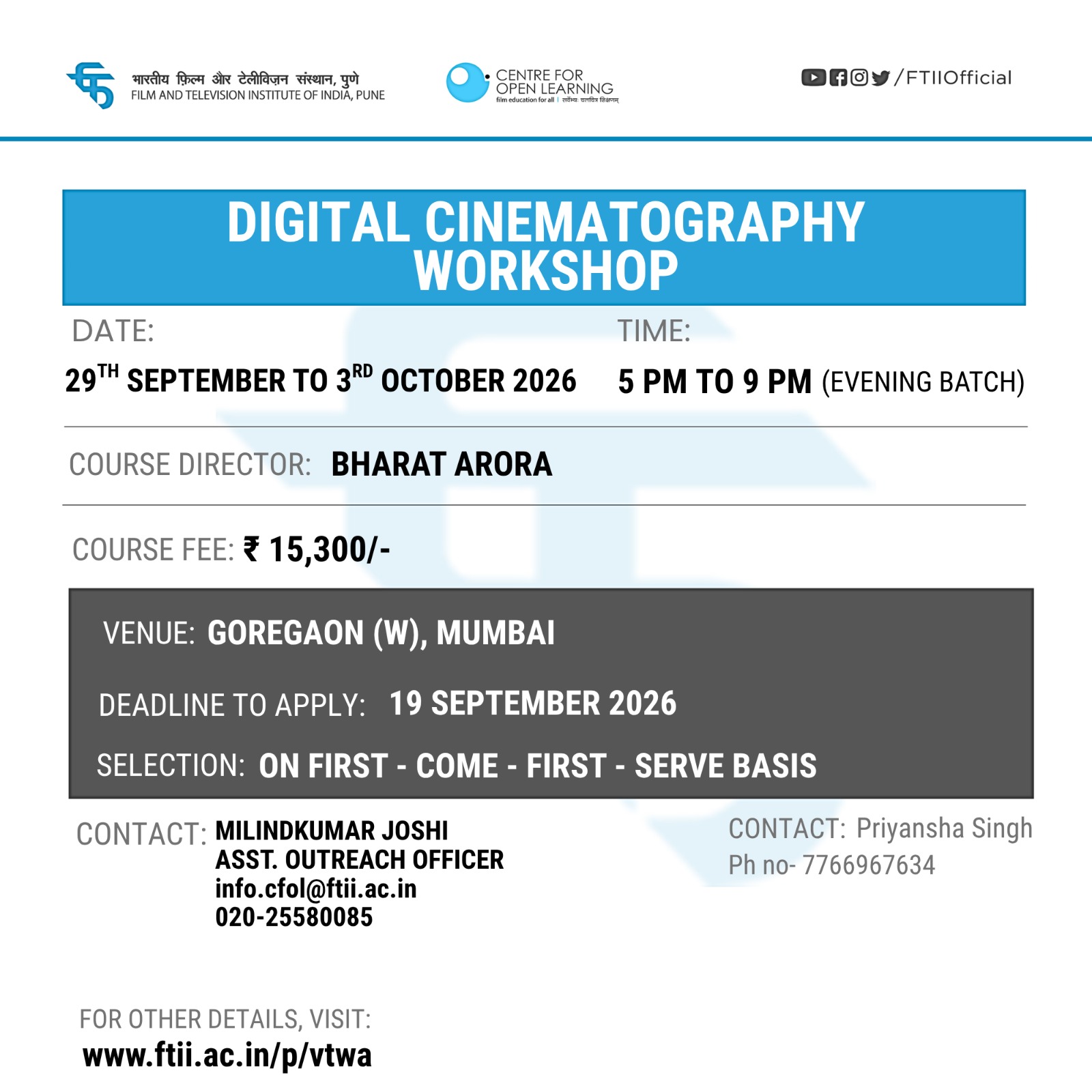
Digital
Cinematography
Workshop
Five days. Every evening. Goregaon, Mumbai. A hands-on course that teaches you to see with the camera — to use light, lens, and exposure as a language for telling stories.
What This Course Is
The digital camera is the most capable tool in the history of cinematography. Knowing how to operate it technically is not enough. This workshop teaches you to see with it — to translate intention into image, scene by scene.
Over five evenings at FTII’s Centre for Open Learning, every session combines two hours of core theory with live hands-on camera work. Participants handle the camera, build lighting setups, operate exposure meters, and shoot real footage that is reviewed and graded as part of the course. No day ends without something in the can.
The course is designed for a mixed audience — whether you are a working professional looking to formalise your craft, or someone beginning their cinematography journey, the curriculum builds from the ground up while giving experienced practitioners a rigorous framework for decisions they already make intuitively.
What We Cover
Understanding the Digital Camera
- The evolution from film to digital — what changed and what didn’t
- Camera anatomy — sensor, processor, mount, recording media
- Sensor size — full frame, Super 35, Micro Four Thirds and how size affects the image
- Resolution, frame rate, bit depth — what each means practically on set
- Codec and recording formats — what to shoot and why
- Log vs standard picture profiles — why you shoot flat and grade later
- Camera menu walkthrough — the 10 settings every cinematographer must know
Exposure & the Lens
- The exposure triangle — aperture, shutter speed, ISO in a digital context
- Native ISO and dual native ISO — where your camera lives cleanly
- The 180° shutter rule — motion blur and why it matters
- ND filters — when, why, and which density to choose
- The exposure meter — incident vs reflective metering, reading for skin
- In-camera histogram and waveform monitor alongside the meter
- Lens vocabulary — focal length, aperture, focus throw, breathing
- Prime vs zoom — the creative and practical case for each
- Understanding bokeh — aperture, focal length, subject distance, sensor size
- Lens character — clinical vs organic, modern vs vintage glass
Lighting for the Digital Image
- Light as language — motivated sources, emotional temperature, directional logic
- Hard light vs soft light — quality, character, and when to choose each
- 3-point lighting — key, fill, rim — understanding the logic, not the formula
- Practical lights — using real-world sources as motivated lighting
- Colour temperature — Kelvin, mixed sources, and the creative use of imbalance
- High-key vs low-key — genre, mood, and emotional encoding through light
- Lighting for skin — the most important subject in cinematography
- Interior vs exterior — controlling and supplementing natural light
- Night and low-light cinematography on digital sensors
Composition & Camera Movement
- The frame as a canvas — aspect ratio, negative space, visual weight
- Rule of thirds, leading lines, depth planes, foreground interest
- Eye-line and screen direction — the grammar of where people look
- Static camera — when stillness is the strongest creative choice
- Motivated movement — pan, tilt, dolly, push, pull, handheld
- The difference between camera movement and camera gymnastics
- Blocking for the camera — working with the director and actors
- Focus as a storytelling tool — rack focus, deep focus, selective focus
- Reading and building a shot list from a scene
Putting It All Together
- The cinematographer’s workflow — prep, shoot, deliver
- Colour science basics — white balance, gamma curves, colour space
- Working with log files — what log is, why it looks flat, what it gives you in the grade
- File handling in post — ingesting, organising, transcoding, protecting footage
- LUT application — technical LUTs vs creative LUTs, when to use each
- A basic grade walkthrough — lift, gamma, gain, saturation, skin tone targeting
- The relationship between the shoot and the grade — expose for the grade, not the monitor
- Continuity — matching light, lens, and colour across a scene
- Working with a director — translating intention into image
How Every Day Runs
| Block | Duration | What Happens |
|---|---|---|
| Theory | 2 hours | Core concepts, principles, and visual references |
| Break | 15 min | — |
| Practical | Remaining | Hands-on camera work, lighting setups, and shooting exercises |
| Review | 30 min | Group critique and instructor feedback on the day’s work |
Workshop Details
Who Should Attend
info.cfol@ftii.ac.in · 020-25580085
7766967634