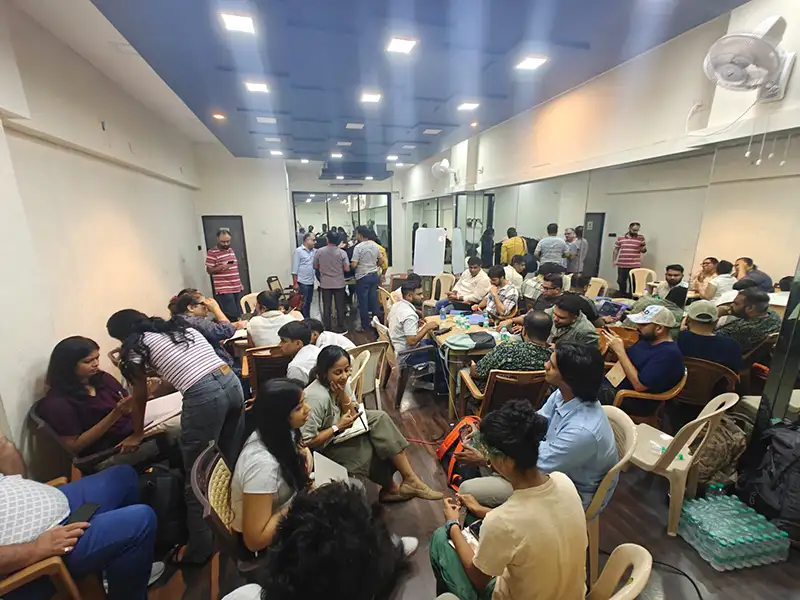
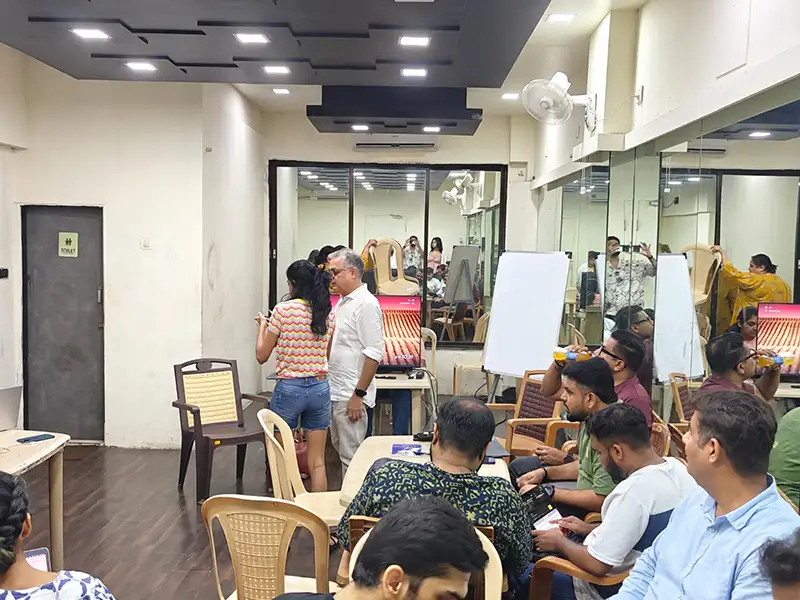
I walked into Hall No. 40 with one conviction: the biggest mistake a filmmaker can make with AI tools is to forget they are, first and foremost, a filmmaker.
Five days later, watching each team screen their completed AI short films — colour-graded, scored, assembled — that conviction had been stress-tested, challenged, and proven right. This workshop was never about learning software. It was about reclaiming the director’s eye in an era of generative everything.
Here is what we built, what we taught, and what I believe every visual storyteller working today needs to understand.
Cinema First. AI Second.
The opening session set the philosophical foundation for everything that followed. My argument was simple: AI tools generate — filmmakers direct. The world’s best cinematographers are your prompt library. The gap between a flat AI output and a genuinely cinematic one is not a technology gap. It is a knowledge gap.
“Every weakness in your prompts is a gap in your cinematic vocabulary. The better you understand Kurosawa’s negative space or Kubrick’s single hard source, the better you can direct an AI generator.”
We spent Day 1 entirely inside the grammar of cinema — not because participants were beginners, but because the same principles that make a shot work on a real set are exactly what make an AI-generated shot feel authored.
Prompting as Direction
Day 2 introduced the four-layer framework I use in my own production work — treating prompt-writing as directing, not searching.
Scene covers world, mood, genre, and time. Shot covers frame type, lens, angle, and lighting. Frame covers subject, expression, and action. Output locks aspect ratio, format, grain, halation, and chromatic aberration. Used together, this turns a vague description into a cinematic brief.
Live Demo 1 made it concrete — the same scene generated twice:
One looked like generated content. The other looked like a frame from a film. From that moment, every participant’s prompts changed permanently.
The Complete Pipeline
AI filmmaking is a chain of eight intentional decisions. Participants who understood this produced work that felt authored. Those who skipped steps produced something that felt assembled.
Tools used across the chain
Tool choice matters far less than the integrity of the chain. A beautifully generated shot assembled without continuity logic — mismatched light temperatures, inconsistent wardrobe, a broken 180° axis — will always feel broken. We drilled continuity checks after every scene block on Day 4.
Day by Day
What the Workshop Proved
By Saturday afternoon, every team had a finished film. Not a mood board, not a test render — a film, with a beginning, middle, and end. Colour-graded. Sound-designed. Screened to the room. Built in three production days by people who, in several cases, had never opened a video generation tool before Monday.
“The participants who produced the strongest work were not the most technically fluent. They were the ones with the clearest visual intention before they touched a single tool.”
This is the lesson I designed the workshop to prove — not assert, but prove. Two full days of cinema grammar before a single frame was generated. The participants who absorbed that foundation produced work with genuine directorial authorship. The AI was their camera operator, their lighting department, their VFX studio. The director was always them.
Thank you to FTII’s Centre for Open Learning for building the institutional space for this kind of conversation, and to every participant who committed fully to the process — especially through the three-day production sprint.
The future of cinema is not automated. It is directed. I hope this week made that argument not in theory, but on screen.
© 2026 Bharat Arora · AI Filmmaking Workshop · FTII Centre for Open Learning, Mumbai